

 Magyar
Organizational operating system
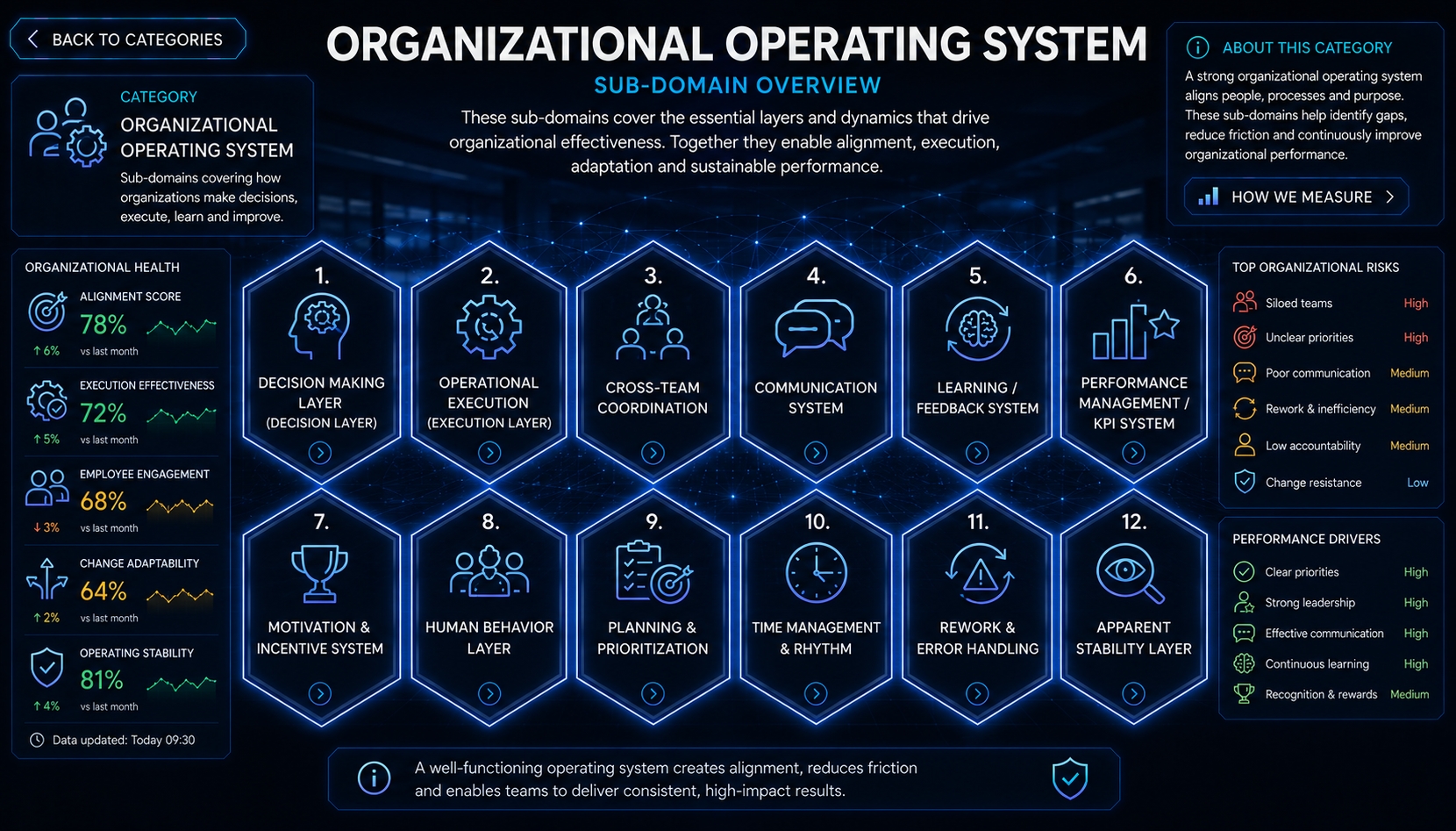
ORGANIZATIONAL OPERATING SYSTEMS
Modern organizations no longer operate through simple processes and hierarchies, but through continuously evolving and interconnected operational networks.
Business workflows, decision-making processes, ERP and enterprise systems, internal coordination, human collaboration, project structures, as well as digital and human operational layers all function simultaneously in constant interaction.
In these environments, even a small coordination disruption can easily propagate throughout the organization, appearing as:
- – backlog waves
– decision delays
– workflow fragmentation
– overloaded operational points
– coordination losses
– hidden capacity losses
– as well as informal workaround systems
AVA-Stabilis observer-only pilots focus on understanding the structural and coordination dynamics behind organizational operations.
We are not building enterprise management systems.
We do not intervene in operational processes.
And we do not modify existing workflows or decision structures.
Our goal is simple: to make operational behavior more understandable within complex organizational environments.
Our investigations may include the analysis of:
- – workflow and backlog wave formation
– downstream operational impacts
– coordination and communication losses
– decision and execution synchronization issues
– hidden operational and capacity losses
– workaround and shadow workflow patterns
– as well as the structural operational dynamics of organizational systems
Our pilots are conducted using an observer-only methodology read-only connectivity:
– minimal and controlled data requirements
– anonymized and aggregated operational signals
– no operational intervention
– no workflow modification
– no operational or business risk
The anonymized investigation reports presented on this page represent observer-only operational-analysis pilots and modeled investigation examples created for various infrastructure and operational environments.
Their purpose is to help prospective partners understand: how AVA-Stabilis approaches complex operational-system analysis, what types of operational patterns and synchronization behaviors are investigated, and which operational-analysis and synchronization-modeling methodologies are exploredacross different real-world infrastructure environments.
The published materials are: anonymized, partially modeled, and demonstration-oriented operational-analysis examples designed to illustrate the research and analytical directions of the platform.
Pilot reports:
1. Decision making layer, PDF
2. Operational execution, PDF
3. Cross-team coordination environment, PDF
4. Communication system, PDF
5. Learning / Feedback system, PDF
6. Performance management / KPI system, PDF
7. Motivation & Incentive system, PDF
8. Human behavior layer, PDF
9. Planning & Prioritization, PDF
10. Time management & rhythm, PDF
11. Rework & Error handling, PDF
12. Apparent stability layer, PDF