

 Magyar
E-commerce
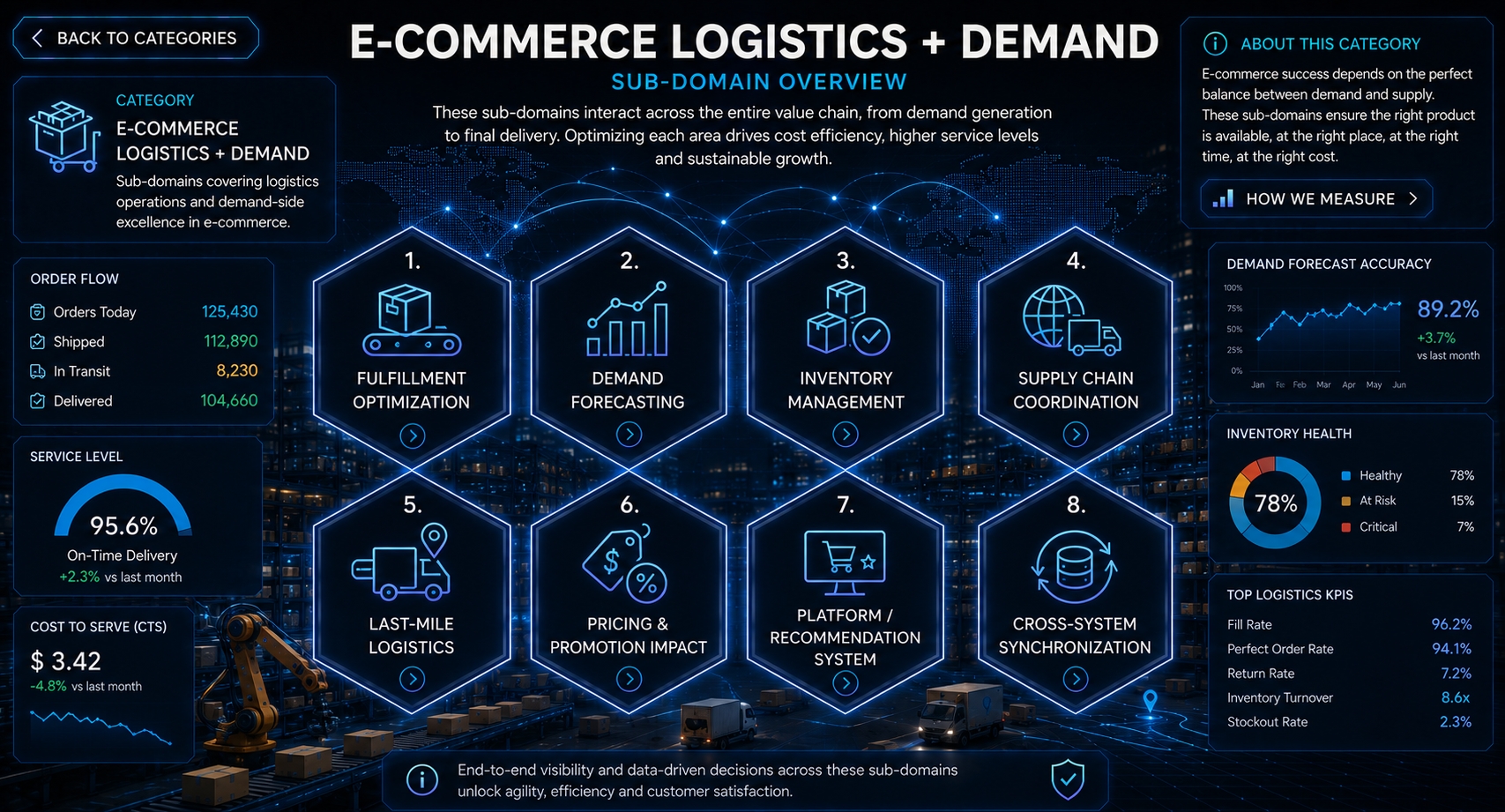
E-COMMERCE LOGISTICS + DEMAND
Modern e-commerce operations are no longer simply about online sales, but about coordinating real-time demand and logistics networks.
Webshops, order waves, inventory-management systems, warehouse workflows, courier networks, promotional campaigns, and continuously changing customer demand all operate in close interaction.
In these environments, even a small operational disruption can rapidly propagate throughout the entire system, appearing as:
- – order congestion
– inventory shortage waves
– fulfillment delays
– logistics overload
– downstream delivery issues
– coordination losses
– as well as hidden capacity losses
AVA-Stabilis observer-only pilots focus on understanding the coordination and demand dynamics behind e-commerce operations.
We are not building webshop platforms.
We do not intervene in operational processes.
And we do not modify existing logistics or sales workflows.
Our goal is simple: to make operational behavior more understandable within rapidly changing demand environments.
Our investigations may include the analysis of:
- – order and demand wave formation
– fulfillment workflow instabilities
– inventory and logistics synchronization issues
– downstream delay propagation
– coordination losses
– hidden capacity losses
– workaround and shadow workflow patterns
– as well as the structural operational dynamics of e-commerce systems
Our pilots are conducted using an observer-only methodology read-only connectivity:
– minimal and controlled data requirements
– anonymized and aggregated operational signals
– no operational intervention
– no workflow modification
– no service disruption risk
The anonymized investigation reports presented on this page represent observer-only operational-analysis pilots and modeled investigation examples created for various infrastructure and operational environments.
Their purpose is to help prospective partners understand: how AVA-Stabilis approaches complex operational-system analysis, what types of operational patterns and synchronization behaviors are investigated, and which operational-analysis and synchronization-modeling methodologies are exploredacross different real-world infrastructure environments.
The published materials are: anonymized, partially modeled, and demonstration-oriented operational-analysis examples designed to illustrate the research and analytical directions of the platform.
Pilot reports:
1. Fulfillment optimization, PDF
2. Demand forecasting, PDF
3. Inventory management, PDF
4. Supply chain coordination, PDF
5. Last-mile logistics, PDF
6. Pricing & promotion impact, PDF
7. Platform / Recommendation system, PDF
8. Cross-system synchronization, PDF